

The Complete Guide to Common Household Pests in Chicago
Learn how to identify the warning signs of ants, rodents, cockroaches, spiders, wasps, bed bugs, and other common Chicago-area pests—and understand when it is time to contact Shepp Pest Control for a professional inspection.
Pest problems rarely happen for just one reason. Food, moisture, shelter, seasonal weather, structural openings, landscaping, and nearby pest pressure can all contribute. Recognizing the early signs can help you address an infestation before it becomes more difficult or expensive to control.
If you've ever spotted a trail of ants across your kitchen floor, heard scratching inside the walls late at night, or discovered a spider web in the basement that seemed to appear overnight, you're certainly not alone. Pest problems are a reality for homeowners throughout Chicago and the surrounding suburbs, regardless of how clean or well-maintained a property may be.
Every season brings different pest challenges. During spring and summer, insects become more active as temperatures rise. In fall, rodents begin searching for warm places to spend the winter. Even during the coldest months, many pests remain active inside homes where food, water, and shelter are readily available.
The good news is that most infestations don't happen overnight. Pests usually leave warning signs long before they become serious problems. Knowing what to look for—and understanding why pests choose certain homes—can help you address issues early and avoid costly damage.
Whether you're dealing with ants in the kitchen, mice in the basement, spiders in the garage, cockroaches in damp areas, or wasps building nests around your home, this guide will help you recognize the signs, understand what attracts each pest, and learn practical ways to reduce future infestations.
Our goal isn't simply to explain how to eliminate pests. We want to help Chicago homeowners understand why infestations happen in the first place, because prevention is almost always easier than dealing with an established colony or nest.
Know the Signs Before They Become a Bigger Problem
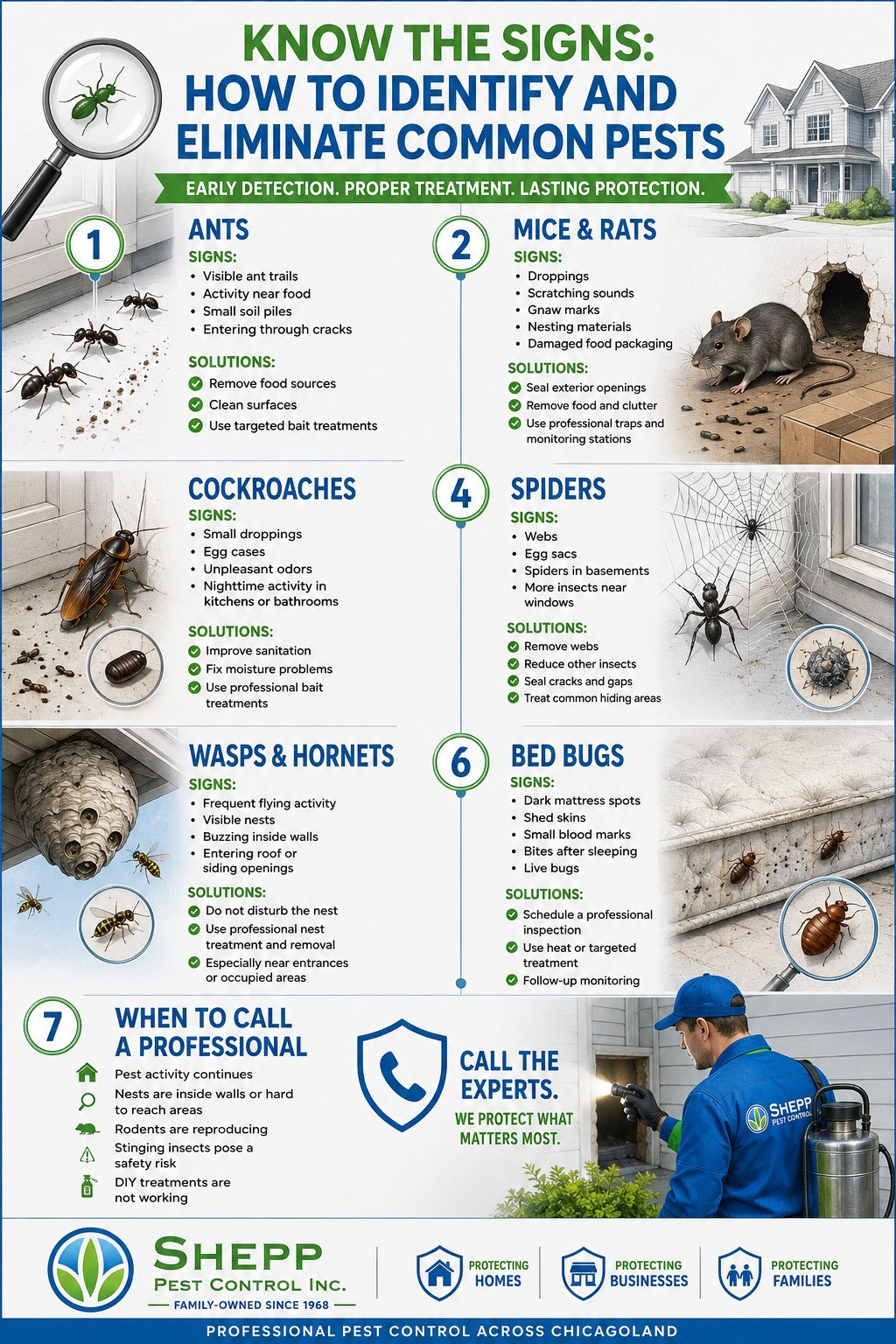
The infographic above provides a quick visual reference for some of the most common pests found throughout Chicago homes. Throughout this guide, we'll expand on each section with practical advice, expert recommendations, seasonal insights, and prevention strategies that go far beyond the basics.
Why Pest Problems Are So Common in Chicago
Chicago presents a unique combination of environmental and structural conditions that allow many pests to thrive throughout the year. Unlike warmer climates where insects remain active almost continuously, Chicago experiences dramatic seasonal changes that actually encourage many pests to move indoors.
Cold winters force rodents to seek shelter inside homes. Wet springs create ideal breeding conditions for ants and other insects. Hot, humid summers increase cockroach, mosquito, and spider activity, while cooler autumn temperatures trigger another wave of pest movement as insects and rodents prepare for winter.
Older neighborhoods add another layer of complexity. Many homes throughout Chicagoland contain aging foundations, utility penetrations, crawl spaces, unfinished basements, and small structural gaps that provide easy entry points for pests.
Even newly built homes aren't immune. Landscaping, nearby construction, neighboring infestations, and weather conditions can all influence pest activity regardless of the age of a property.
Why Clean Homes Still Get Pests
One of the biggest misconceptions about pest control is that pests only invade dirty homes.
In reality, cleanliness is only one small factor.
Pests are driven by survival—not by whether a house looks clean.
Most are simply searching for four basic necessities:
- ✅ Food
- ✅ Water
- ✅ Shelter
- ✅ Safe places to reproduce
A spotless kitchen may still have plumbing moisture beneath the sink.
A beautiful finished basement may hide foundation cracks behind drywall.
A perfectly landscaped yard may contain mulch beds that hold moisture and shelter insects.
Even homes that receive regular cleaning can develop pest problems if these conditions exist.
This is why professional pest inspections focus on much more than sanitation. Understanding the environment surrounding the home is equally important.
The Seven Warning Signs Every Homeowner Should Never Ignore
Most infestations begin quietly.
Rather than seeing dozens of insects immediately, homeowners usually notice small clues that something isn't quite right.
Learning to recognize these early warning signs can often prevent a minor issue from becoming a major infestation.
✅ 1. Strange Scratching Sounds
If you hear scratching, scurrying, or light tapping inside walls or ceilings—particularly at night—it may indicate rodents moving through wall voids or attic spaces.
While pipes and settling noises are common in many homes, repeated sounds occurring in the same location deserve closer attention.
✅ 2. Small Droppings
Finding droppings beneath sinks, inside cabinets, along basement walls, or behind appliances is often one of the clearest indicators of pest activity.
Different pests leave different types of droppings, making identification an important first step toward determining the source of the problem.
✅ 3. Unusual Odors
Persistent musty, oily, or ammonia-like smells may indicate hidden pest activity.
Rodents often leave urine odors along travel routes, while cockroach infestations can produce a distinct unpleasant smell as populations grow.
If an odor appears without an obvious explanation, it's worth investigating further.
✅ 4. Chewed Materials
Many pests leave physical evidence behind.
Look for:
- ✅ Chewed food packaging
- ✅ Damaged cardboard boxes
- ✅ Gnawed wood
- ✅ Torn insulation
- ✅ Frayed electrical wiring
Rodents constantly chew to prevent their teeth from becoming overgrown, making chew marks one of the earliest warning signs.
✅ 5. Webs Appearing More Frequently
Finding the occasional spider web isn't unusual.
However, if new webs appear shortly after cleaning, it may indicate increasing insect activity inside the home.
Remember, spiders rarely stay where there isn't food.
✅ 6. Tiny Openings Around the Home
Many infestations begin because pests discover a simple way inside.
Inspect your property regularly for:
- ✅ Foundation cracks
- ✅ Damaged weather stripping
- ✅ Utility line openings
- ✅ Loose siding
- ✅ Gaps beneath garage doors
Even surprisingly small openings can become major access points.
✅ 7. Seeing Pests During Daylight
Many household pests prefer darkness.
Seeing rodents or cockroaches during the day sometimes suggests a larger population competing for food and hiding space.
While daytime sightings don't always indicate severe infestations, they often deserve closer attention.
Understanding How Pests Enter Your Home
Most homeowners imagine pests somehow "appearing" inside.
In reality, nearly every infestation begins with an entry point.
Some are obvious.
Others are almost impossible to notice without careful inspection.
Common access points include:
- ✅ Foundation cracks
- ✅ Utility penetrations
- ✅ Roof vents
- ✅ Crawl space openings
- ✅ Dryer vents
- ✅ Basement windows
- ✅ Damaged door sweeps
- ✅ Garage door gaps
Mice only need an opening about the width of a pencil.
Many insects require even less space.
That's why exclusion—physically preventing pests from entering—is one of the most effective long-term pest control strategies available.
Moisture: The Hidden Pest Magnet
If there is one factor that contributes to more infestations than almost anything else, it is moisture.
Water supports nearly every type of pest.
Leaks beneath sinks.
Standing water near foundations.
Condensation around plumbing.
Poor drainage.
Overflowing gutters.
Humid crawl spaces.
These conditions don't just attract insects.
They also create ideal environments for mold, wood decay, and structural damage that may later invite even more pests.
Reducing moisture around the home is one of the simplest and most effective preventive measures homeowners can take.
Why Some Homes Experience More Pest Problems Than Others
Have you ever noticed that one house on a street constantly battles pest problems while neighboring homes rarely do?
Several factors may explain the difference.
Properties surrounded by mature landscaping often experience greater insect activity because vegetation provides shade, moisture, and natural shelter.
Homes located near wooded areas, parks, ponds, rivers, or retention basins may see increased seasonal pest pressure due to nearby wildlife and breeding habitats.
Older homes sometimes have settled foundations, aging utility penetrations, or decades of minor structural wear that create countless tiny entry points. Newer homes, on the other hand, may still experience pest issues if landscaping, drainage, or neighboring infestations create favorable conditions.
Even renovation projects can temporarily increase pest activity by disturbing existing nests or exposing new access points around the structure.
The important takeaway is that pest infestations are rarely caused by a single issue. More often, they result from a combination of environmental conditions, structural vulnerabilities, and seasonal behavior.
Meet the Most Common Household Pests in Chicago
Not all pests behave the same way.
Some invade homes looking for food.
Others seek moisture.
Some arrive seasonally, while others remain active year-round once they establish themselves indoors.
In the following sections, we'll take a closer look at each of the most common household pests found throughout Chicago and Chicagoland. You'll learn how to recognize early warning signs, understand what attracts them, and discover practical ways to reduce the likelihood of future infestations before they become much larger problems.
Common Household Pests Found in Chicago Homes
Every pest behaves differently. Some quietly establish colonies beneath your foundation, while others move indoors only when temperatures change. Understanding how each pest operates makes it much easier to recognize problems early and choose the right solution.
Let's begin with two of the most common calls we receive throughout Chicagoland: ants and rodents.
🐜 Ants: Small Insects That Can Lead to Big Problems
Many homeowners don't think much about ants until they discover a trail stretching across the kitchen floor. By that point, however, the colony has usually been active for quite some time.
Ants rarely wander randomly. When you see a line of ants, they are following invisible pheromone trails left by scout ants that have already located food or water inside your home.
The ants you see are only a small fraction of the colony. Thousands more may remain hidden outdoors beneath sidewalks, landscaping, patios, or even underneath your home's foundation.
✅ Why Ants Invade Homes
Ants enter homes for one simple reason—they've found something worth returning for.
The most common attractants include:
- ✅ Crumbs left beneath appliances
- ✅ Sugary drinks
- ✅ Pet food bowls
- ✅ Grease buildup around stoves
- ✅ Standing water
- ✅ Plumbing leaks
Even tiny amounts of food that people barely notice can support hundreds of foraging ants.
✅ The Most Common Ants Found in Chicago
Not every ant species behaves the same way. Identifying the type of ant often determines the best treatment strategy.
Pavement Ants
These are the ants most Chicago homeowners encounter.
They typically build nests beneath:
- ✅ Sidewalks
- ✅ Driveways
- ✅ Patios
- ✅ Basement floors
After heavy rain or warm weather, they often move indoors searching for food.
Carpenter Ants
Carpenter ants are much larger than pavement ants and deserve special attention.
Unlike termites, they do not eat wood.
Instead, they tunnel through damp or decaying wood to build nesting galleries.
Finding carpenter ants may indicate hidden moisture problems somewhere inside the structure.
Common nesting locations include:
- ✅ Window frames
- ✅ Roof leaks
- ✅ Damp wall cavities
- ✅ Deck supports
- ✅ Water-damaged lumber
Odorous House Ants
These tiny ants are well known for the unpleasant odor they produce when crushed.
They frequently invade:
- ✅ Kitchens
- ✅ Bathrooms
- ✅ Laundry rooms
- ✅ Utility closets
They often establish multiple satellite colonies, making them especially difficult to eliminate without addressing the entire colony.
Why Store-Bought Ant Sprays Usually Don't Solve the Problem
Many homeowners immediately reach for an aerosol spray after seeing ants.
The spray works.
At least temporarily.
But here's the problem...
The ants you kill are simply the workers.
The queen—and often thousands of additional ants—remain safely hidden inside the nest.
In many cases, spraying visible ants actually makes treatment more difficult by causing colonies to split and relocate.
Long-term ant control focuses on eliminating the colony itself, not just the ants you happen to see walking across the counter.
How to Make Your Home Less Attractive to Ants
Preventing ant infestations is often easier than eliminating an established colony.
Simple maintenance goes a long way.
Consider these habits:
- ✅ Wipe countertops daily.
- ✅ Store dry food in sealed containers.
- ✅ Clean beneath kitchen appliances regularly.
- ✅ Repair leaking faucets.
- ✅ Empty indoor trash frequently.
- ✅ Trim vegetation touching the home.
- ✅ Keep mulch several inches away from the foundation.
These small changes reduce the food, moisture, and shelter ants depend on.
🐭 Mice and Rats: Chicago's Most Persistent Pest Problem
Few pests create more concern than rodents.
Unlike insects, rodents can cause significant property damage while also contaminating food and creating potential health concerns.
Chicago has battled rodent problems for decades.
Dense neighborhoods, aging infrastructure, extensive alley systems, and harsh winters create ideal conditions for both mice and rats to thrive.
Even homes that appear well sealed can become vulnerable if tiny structural openings exist.
Mice vs. Rats: What's the Difference?
Although homeowners often use the terms interchangeably, mice and rats behave quite differently.
House Mice
House mice are:
- ✅ Smaller
- ✅ Curious
- ✅ Excellent climbers
- ✅ Fast breeders
Because of their size, they can enter through openings no larger than the diameter of a pencil.
Once inside, they often nest inside:
- ✅ Wall cavities
- ✅ Insulation
- ✅ Ceiling voids
- ✅ Storage boxes
- ✅ Basement shelving
Norway Rats
Norway rats are larger, stronger, and far more destructive.
They frequently burrow beneath:
- ✅ Foundations
- ✅ Concrete slabs
- ✅ Outdoor sheds
- ✅ Decks
They typically enter homes through damaged foundations, utility openings, or poorly sealed crawl spaces.
Why Rodents Love Chicago Winters
Every autumn, pest professionals notice the same pattern.
Temperatures begin falling...
Rodent activity increases.
It's no coincidence.
Rodents know winter is coming.
Instead of remaining outdoors, they begin searching for warm structures that provide consistent shelter.
Your home offers everything they need.
Warmth.
Food.
Water.
Protection.
Once inside, many rodents remain active throughout the entire winter.
The Warning Signs Most Homeowners Miss
Many infestations begin weeks—or even months—before homeowners realize rodents are present.
Some of the earliest clues include:
Small Droppings
Often found:
- ✅ Under sinks
- ✅ Behind refrigerators
- ✅ Inside pantries
- ✅ Along basement walls
Gnaw Marks
Rodents constantly chew.
Look for damage on:
- ✅ Food packaging
- ✅ Cardboard boxes
- ✅ Plastic containers
- ✅ Wood trim
Scratching Sounds
Nighttime scratching inside:
- ✅ Walls
- ✅ Ceilings
- ✅ Attics
- ✅ Crawl spaces
often indicates active movement.
Grease Marks
Rodents frequently travel the same pathways.
Over time, oils from their fur leave dark smudge marks along:
- ✅ Baseboards
- ✅ Pipes
- ✅ Foundation walls
Nesting Material
Mice commonly shred:
- ✅ Paper
- ✅ Insulation
- ✅ Fabric
- ✅ Cardboard
to create warm nesting areas.
Why Rodents Can Cause More Damage Than People Expect
Rodents don't simply eat food.
They chew constantly.
Over time they may damage:
- ✅ Electrical wiring
- ✅ Plumbing insulation
- ✅ HVAC ductwork
- ✅ Stored belongings
- ✅ Drywall
- ✅ Furniture
Electrical damage is particularly concerning because exposed wiring can increase fire risk.
Can One Mouse Become a Bigger Problem?
Unfortunately...
Yes.
Homeowners often believe catching one mouse solves the issue.
In reality, the visible mouse may only represent a much larger hidden population.
Rodents reproduce surprisingly quickly under favorable conditions.
If food, water, and shelter remain available, populations can increase much faster than most people realize.
For that reason, addressing the underlying cause of the infestation—not simply removing one rodent—is essential for long-term success.
Why Exclusion Is One of the Best Investments You Can Make
Professional pest control isn't only about removing pests.
It's also about preventing them from returning.
This process is known as exclusion.
Rather than focusing solely on traps or bait, exclusion identifies and seals the entry points rodents use to enter the structure.
Some of the most common exclusion improvements include:
- ✅ Sealing utility penetrations
- ✅ Repairing damaged foundation gaps
- ✅ Installing proper door sweeps
- ✅ Screening exterior vents
- ✅ Repairing damaged soffits
Without exclusion work, new rodents can simply replace the ones that were removed.
If you've started noticing droppings, scratching noises, chew marks, or unusual activity around your home, it's often worth investigating sooner rather than later. Rodent infestations rarely improve on their own, and early intervention is almost always easier—and less costly—than waiting until the problem becomes more widespread.
For homeowners throughout Chicagoland, recurring ant and rodent problems often stem from hidden structural issues rather than housekeeping. That's why companies like Shepp Pest Control begin with a thorough inspection to identify not just the pests, but the conditions allowing them to thrive.
🪳 Cockroaches: Why They're So Difficult to Eliminate
Few household pests create as much concern as cockroaches. They reproduce quickly, hide exceptionally well, and can survive in environments where many other insects cannot. By the time homeowners begin seeing cockroaches regularly, the infestation is often much larger than it appears.
Unlike many seasonal pests, cockroaches can remain active year-round inside heated homes and commercial buildings.
✅ Why Cockroaches Invade Homes
Cockroaches don't enter homes because they're dirty. They enter because a home provides the three things they need most:
- ✅ Food
- ✅ Water
- ✅ Warmth
Even small amounts of moisture beneath a sink or crumbs behind a refrigerator can support an active population.
Apartments, condominiums, restaurants, and homes with shared walls often experience recurring infestations because cockroaches can travel between neighboring units.
✅ Common Cockroach Species in Chicago
German Cockroach
The German cockroach is the most common indoor species found throughout Chicago.
They prefer:
- ✅ Kitchens
- ✅ Bathrooms
- ✅ Laundry rooms
- ✅ Utility closets
Because they reproduce extremely quickly, even a small infestation can become a major problem within weeks.
Oriental Cockroach
Often called "water bugs," Oriental cockroaches prefer cool, damp environments.
They're commonly found around:
- ✅ Floor drains
- ✅ Basements
- ✅ Crawl spaces
- ✅ Utility rooms
✅ Signs of a Cockroach Infestation
Cockroaches spend much of their time hidden inside cracks, behind appliances, and inside cabinets.
Watch for:
- ✅ Small dark droppings
- ✅ Egg capsules
- ✅ Shed skins
- ✅ Musty odors
- ✅ Live insects when lights are turned on
Seeing cockroaches during daylight often indicates a larger hidden population competing for food and shelter.
✅ Preventing Cockroach Problems
The best prevention strategy combines sanitation with moisture control.
Helpful practices include:
- ✅ Repair plumbing leaks
- ✅ Vacuum behind appliances
- ✅ Keep garbage containers sealed
- ✅ Store food in airtight containers
- ✅ Reduce clutter beneath sinks
🕷️ Spiders: Helpful Hunters or Household Nuisance?
Most spiders found throughout Chicago are harmless and actually feed on nuisance insects.
However, when spider activity increases inside a home, it often indicates another pest problem nearby.
Rather than asking,
"How do I get rid of spiders?"
A better question is:
"Why are spiders finding enough food to stay?"
✅ Why Spiders Keep Returning
Spiders remain where insects are abundant.
If your home supports:
- ✅ Flies
- ✅ Gnats
- ✅ Ants
- ✅ Small crawling insects
spiders will naturally follow.
Removing their food source often reduces spider activity dramatically.
✅ Where Spiders Hide
Spiders prefer quiet, undisturbed locations such as:
- ✅ Basements
- ✅ Crawl spaces
- ✅ Attics
- ✅ Garages
- ✅ Storage rooms
Regular cleaning helps, but eliminating insects and sealing entry points provides much longer-lasting results.
🐝 Wasps & Hornets: A Problem That Shouldn't Be Ignored
Unlike ants or spiders, wasps and hornets present an immediate safety concern.
Their nests continue growing throughout spring and summer, sometimes containing hundreds—or even thousands—of insects by late season.
Attempting to remove large nests without proper equipment can be dangerous.
✅ Where Wasps Commonly Build Nests
Homeowners frequently discover nests:
- ✅ Under roof overhangs
- ✅ Inside soffits
- ✅ Beneath decks
- ✅ Around sheds
- ✅ Inside wall voids
Early removal is generally much easier than waiting until late summer.
✅ Why Wasps Become More Aggressive
Many people notice wasps becoming increasingly aggressive in late summer.
That's because colonies are at their largest.
More insects mean greater competition for food and stronger defensive behavior around the nest.
🛏️ Bed Bugs: One of the Most Misunderstood Household Pests
Bed bugs have nothing to do with cleanliness.
They travel.
A spotless home can develop a bed bug infestation just as easily as any other property.
Bed bugs commonly arrive after:
- ✅ Travel
- ✅ Hotel stays
- ✅ Used furniture
- ✅ Apartment migration
- ✅ Guests
Once introduced, they hide remarkably well.
✅ Early Signs of Bed Bugs
Many infestations begin without homeowners ever seeing an actual bed bug.
Instead, they notice:
- ✅ Small bites
- ✅ Tiny blood spots on sheets
- ✅ Dark spotting around mattresses
- ✅ Shed skins
- ✅ Live insects hidden near seams
Because bed bugs reproduce quickly, early identification is extremely important.
✅ Why DIY Bed Bug Treatments Often Fail
Many over-the-counter sprays only affect exposed insects.
Unfortunately, bed bugs spend much of their lives hidden inside:
- ✅ Mattresses
- ✅ Box springs
- ✅ Furniture joints
- ✅ Baseboards
- ✅ Wall voids
Successful treatment requires locating every stage of the infestation—not simply treating visible insects.
📅 The Chicago Seasonal Pest Calendar
One reason pest control is never "one and done" is that different pests become active throughout different times of the year.
Understanding seasonal activity helps homeowners prepare before infestations begin.
🌸 Spring
As temperatures rise, many overwintering insects become active.
Common spring pests include:
- ✅ Ants
- ✅ Spiders
- ✅ Wasps
- ✅ Earwigs
Spring is also one of the best times to schedule preventive inspections.
☀️ Summer
Warm temperatures accelerate insect activity.
Homeowners commonly encounter:
- ✅ Ants
- ✅ Cockroaches
- ✅ Mosquitoes
- ✅ Wasps
- ✅ Flies
Food, moisture, and outdoor activity increase pest pressure during these months.
🍂 Fall
Fall is one of the busiest pest seasons.
As temperatures cool:
- ✅ Mice move indoors.
- ✅ Rats search for shelter.
- ✅ Spiders become more visible.
- ✅ Stink bugs seek overwintering sites.
This is one of the most important times for preventive pest control.
❄️ Winter
Although many insects become inactive outdoors, indoor pest activity often continues.
Winter commonly brings:
- ✅ Rodents
- ✅ Cockroaches
- ✅ Spiders
because heated homes provide ideal shelter.
DIY Pest Control vs. Professional Pest Control
Many homeowners successfully solve small pest issues using simple preventive measures.
However, larger infestations often require a more comprehensive approach.
DIY works well for:
- ✅ Cleaning food spills
- ✅ Sealing small gaps
- ✅ Reducing moisture
- ✅ Removing outdoor attractants
Professional treatment becomes valuable when:
- ✅ Pests repeatedly return
- ✅ Multiple rooms are affected
- ✅ Rodents are present
- ✅ Nests cannot be located
- ✅ The infestation continues growing
The goal should always be long-term prevention—not temporary relief.
The Ultimate Chicago Home Pest Prevention Checklist
Simple habits make a significant difference.
Every Week
- ✅ Clean kitchen counters.
- ✅ Vacuum beneath furniture.
- ✅ Empty indoor trash.
- ✅ Check pet feeding areas.
Every Month
- ✅ Inspect the basement.
- ✅ Look for plumbing leaks.
- ✅ Check weather stripping.
- ✅ Remove spider webs.
Every Season
- ✅ Clean gutters.
- ✅ Trim vegetation.
- ✅ Inspect the foundation.
- ✅ Seal exterior openings.
- ✅ Schedule a pest inspection if recurring activity is noticed.
Why Professional Inspections Save Money
One of the biggest misconceptions is that pest control only becomes necessary after an infestation is obvious.
In reality, professional inspections often identify problems long before homeowners notice them.
Finding a small foundation gap is far less expensive than repairing rodent damage months later.
Addressing moisture issues early can prevent carpenter ants, cockroaches, and other moisture-loving pests from becoming established.
For homeowners throughout Chicagoland, regular inspections are often one of the most cost-effective ways to protect both the home and the family.
At Shepp Pest Control, every inspection focuses on more than simply identifying pests. We look for the conditions that allow infestations to develop, helping homeowners solve the problem at its source rather than treating the symptoms alone.
Frequently Asked Questions About Household Pests in Chicago
✅ What is the most common household pest in Chicago?
Rodents, ants, cockroaches, spiders, bed bugs, and wasps are among the most common pests found in Chicago homes.
✅ Why do pests keep coming back?
Recurring infestations usually indicate that entry points, moisture problems, food sources, or nesting locations have not been fully addressed.
✅ Do clean homes get pests?
Yes. Even very clean homes can experience pest problems if they provide food, water, or shelter.
✅ What time of year are pests most active?
Different pests become active throughout the year, but spring, summer, and fall generally produce the highest levels of pest activity.
✅ Can I eliminate pests myself?
Small problems may be manageable through prevention and sanitation, but larger infestations often require professional inspection and treatment.
✅ How often should pest control be performed?
Many homeowners benefit from seasonal or quarterly inspections to help prevent infestations before they become established.
✅ What attracts rodents?
Rodents are attracted by food, water, warmth, clutter, and structural openings that provide access to shelter.
✅ Why do I suddenly have ants?
Ants usually enter homes after scout ants discover food or moisture and establish scent trails for the rest of the colony.
✅ Are spiders a sign of another pest problem?
Often, yes. Large spider populations usually indicate that insects are available as a food source.
✅ What should I do if I find a wasp nest?
Avoid disturbing the nest and keep children and pets away. Large or active nests are generally safest to have removed by professionals.
✅ Can bed bugs spread from neighboring apartments?
Yes. Bed bugs can travel between connected units through walls, electrical outlets, plumbing penetrations, and shared spaces.
✅ What's the best way to prevent pests year-round?
Regular inspections, moisture control, sanitation, sealing entry points, and preventive maintenance provide the best long-term protection.
Protect Your Home Before Small Pest Problems Become Bigger Ones
Frequently Asked Questions About Household Pests in Chicago
✅ What is the most common household pest in Chicago?
Rodents, ants, cockroaches, spiders, bed bugs, and wasps are among the most common pests found in Chicago homes.
✅ Why do pests keep coming back?
Recurring infestations usually indicate that entry points, moisture problems, food sources, or nesting locations have not been fully addressed.
✅ Do clean homes get pests?
Yes. Even very clean homes can experience pest problems if they provide food, water, or shelter.
✅ What time of year are pests most active?
Different pests become active throughout the year, but spring, summer, and fall generally produce the highest levels of pest activity.
✅ Can I eliminate pests myself?
Small problems may be manageable through prevention and sanitation, but larger infestations often require professional inspection and treatment.
✅ How often should pest control be performed?
Many homeowners benefit from seasonal or quarterly inspections to help prevent infestations before they become established.
✅ What attracts rodents?
Rodents are attracted by food, water, warmth, clutter, and structural openings that provide access to shelter.
✅ Why do I suddenly have ants?
Ants usually enter homes after scout ants discover food or moisture and establish scent trails for the rest of the colony.
✅ Are spiders a sign of another pest problem?
Often, yes. Large spider populations usually indicate that insects are available as a food source.
✅ What should I do if I find a wasp nest?
Avoid disturbing the nest and keep children and pets away. Large or active nests are generally safest to have removed by professionals.
✅ Can bed bugs spread from neighboring apartments?
Yes. Bed bugs can travel between connected units through walls, electrical outlets, plumbing penetrations, and shared spaces.
✅ What's the best way to prevent pests year-round?
Regular inspections, moisture control, sanitation, sealing entry points, and preventive maintenance provide the best long-term protection.
Protect Your Home Before Small Pest Problems Become Bigger Ones
Pest control isn't simply about eliminating insects or rodents after they appear. It's about understanding why they arrived in the first place and making your home less inviting in the future.
Every home is different. Construction style, neighborhood, landscaping, seasonal weather, and even nearby properties all influence pest activity. The most effective pest management plans combine prevention, early detection, and targeted treatment when necessary.
Whether you've noticed the first signs of an infestation or simply want greater peace of mind, taking action early is almost always the smartest investment.
If you're looking for experienced, family-owned pest control in the Chicago area, Shepp Pest Control has been helping homeowners and businesses throughout Chicagoland since 1968. Our team provides honest inspections, effective treatments, and long-term pest management solutions designed specifically for the unique challenges of our local communities.
Pest Control Service Areas in Chicagoland
Shepp Pest Control proudly serves homeowners and businesses throughout Chicago, Palatine, Arlington Heights, Park Ridge, Schaumburg, Des Plaines, Rolling Meadows, Barrington, Glenview, Northbrook, the North Shore, and many surrounding Chicagoland communities. We also provide pest control services as far west as Hampshire, as far north as Gurnee, and as far south as Orland Park and other nearby suburbs.

Professional Pest Control From a Chicagoland Company You Can Call
Shepp Pest Control Inc. is a family-owned pest-control company serving Chicagoland homes and businesses since 1968.
Led by Mark Siepka and Supported by a Hands-On Local Team
Mark Siepka began working with his father at age 16 and now leads Shepp Pest Control Inc. He continues to perform inspections and service calls personally.
Mark works closely with Laura Charnota, who helps oversee scheduling, customer service, and daily operations.
Request a Professional Property Inspection
Tell Shepp Pest Control what you are seeing, where the activity is occurring, and how long it has continued.

Greater Chicago Pest Management Alliance Member
Shepp Pest Control Inc. is a member of the Greater Chicago Pest Management Alliance .

This article was researched and edited by Nick Fivera Petrovic, an SEO strategist and digital publisher with Website Marketing of Florida. The content was prepared using information provided and reviewed by the Shepp Pest Control team to ensure it accurately reflects the company’s services, experience, and recommendations.
Request Pest-Control Service
Tell the Shepp Pest Control team what activity you are seeing, where it is occurring, and how long it has continued. Complete the form below or call 708-975-4771.